
Aadhaar enrolment is the process through which a resident of India applies for a new Aadhaar card for the first time. It involves submitting basic personal details and biometric information such as fingerprints, iris scan, and photograph at an authorised UIDAI enrolment center.
Once the enrolment is completed, UIDAI verifies the information and issues a unique 12-digit Aadhaar number to the applicant.
Features of Aadhaar
Aadhaar offers a secure and unique digital identity that helps residents of India access government and private services easily and safely.
| Feature | Description |
|---|---|
| Unique 12-Digit Number | Every Aadhaar holder receives a unique identification number that does not duplicate with anyone else |
| Biometric Based | Aadhaar is linked with fingerprints, iris scan, and facial photograph for accurate identification, It collects 10 fingerprints, dual iris scans, and facial photos, achieving a false acceptance rate under 0.01% for de-duplication. The 2025 updates include facial authentication for seniors over 70 to address fingerprint degradation issues. |
| Nationwide Validity | Aadhaar is valid across all states and union territories in India |
| Digital and Paperless | Aadhaar is available in electronic form (e-Aadhaar, mAadhaar, DigiLocker) |
| Online Services | Aadhaar services like download, update, status check, and e-KYC are available online |
| Identity Verification | Aadhaar is widely accepted as proof of identity and address |
| Secure Authentication | UIDAI uses OTP, biometrics, and Virtual ID for verification |
| Privacy Protection | Options like masked Aadhaar and biometric locking help protect user data |
| Free Enrolment | First-time Aadhaar enrolment is completely free |
| Used Across Services | Aadhaar is used for banking, mobile SIM, government schemes, and more |
Eligibility Criteria
Eligibility extends to all Indian residents, with tailored provisions for diverse groups:
- General Residents: Anyone who has resided in India for 182 or more days in the prior 12 months qualifies, from newborns to seniors. There are no age, gender, or citizenship barriers, but 2025’s stricter checks exclude illegal immigrants through database cross-verification.
- Children: It is open to all ages. For those born after October 1, 2023, a birth certificate is mandatory.
- Under 5: It links to a parent or guardian’s Aadhaar with their biometric authentication.
- Ages 5-18: Own biometrics are required. NRI minors need parental consent and a valid Indian passport.
- NRIs and OCI Holders: They are eligible after a 182-day stay, requiring a valid Indian passport or OCI card plus foreign passport. Unique: OCI holders from UAE can apply if meeting residency, aiding NRI banking.
- Foreign Nationals: It applies to long-term visa holders, such as LTV for minorities from Afghanistan, Bangladesh, or Pakistan with a foreign passport, or others with 182-day stay proof. Nepalese or Bhutanese need a citizenship certificate and mission-issued photo ID.
- Special Groups: Homeless or shelter residents use warden certificates. Prisoners qualify via PID with a prison officer seal. Transgenders are eligible with a 2019 Act ID.
Enrolment Process
Enrolment is offline only, requiring physical presence at authorized centres with no full online or postal options, The steps are:
- Find a Enrolment Centre: Locate one via the UIDAI website (uidai.gov.in) or mAadhaar app, You can book appointments online by clicking on My Aadhar on the homepage and then selecting “Book an appointment”.
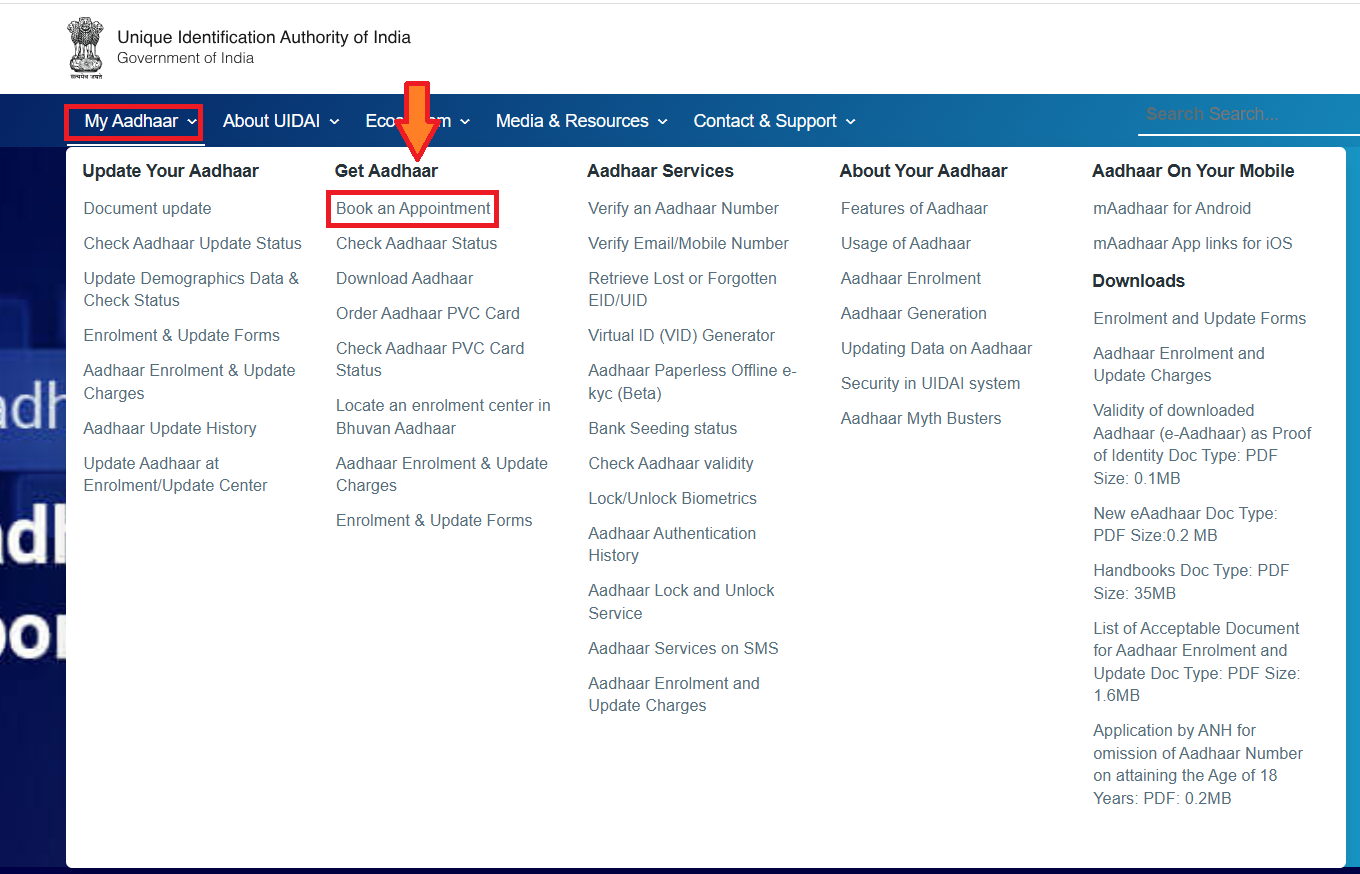
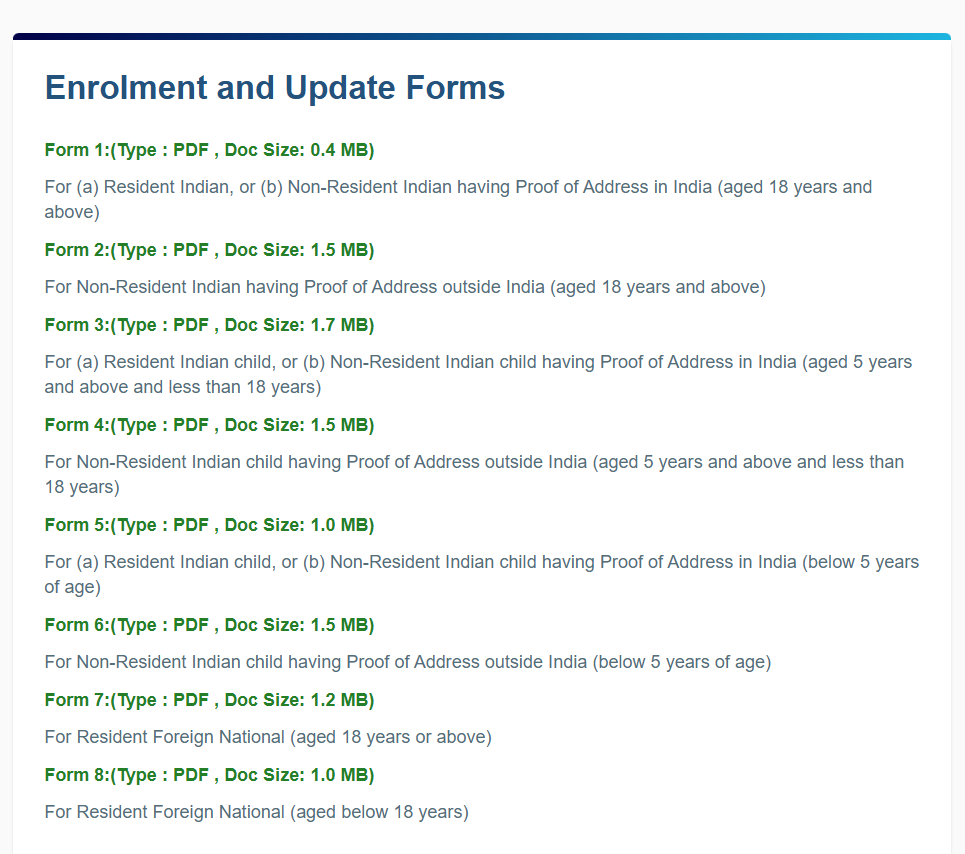
- Select and Fill the Appropriate Form: Choose the form based on your category (e.g., Form 1 for adult residents/NRIs with Indian address, Form 3 for children 5-18). Forms are available in English and can be downloaded from the UIDAI site. Enter details like name, DOB or age, gender, address, and optional mobile or email (vital for updates). For those without documents, use the Head of Family (HoF) introduction with POR like a birth certificate.
- Gather Documents: Prepare originals for POI, POA, DOB, and POR. The 2025 mandates include real-time digital cross-checks with utility or PAN databases to flag fakes, resulting in blacklisting if fraudulent.
- Attend the Centre: It is free for new enrolments. Children under 5 need a parent for biometric consent.
- Complete the Form: Enter details like name, DOB or age, gender, address, and optional mobile or email (vital for updates). For those without documents, use the Head of Family (HoF) introduction with POR like a birth certificate.
- Biometric Capture: Include photo, fingerprints, and iris scans. Exemptions for missing limbs or eyes use alternatives. Children under 5 skip this; NRIs and foreigners follow the same process, with residency proof verified.
- Document Submission: The operator scans and verifies. For transgenders, a 2019 Act certificate is accepted. If HoF-based, family links are confirmed.
- Get Acknowledgement: Receive an Enrolment ID (EID) slip for status tracking via the 1947 helpline or portal. Processing takes up to 90 days.
Documents Required for Aadhaar Enrolment
All documents must be original and valid per UIDAI’s. Proof of Identity needs name and photo, and Proof of Address must show the current address. Cross-verification is mandatory; fake or mismatched papers will be rejected. Children born after October 1, 2023 require a birth certificate.
Note: If you lack documents, enrol through an Introducer such as a Head of Family or Gazetted Officer. For children under five, only a passport, government photo ID, ST/SC/OBC certificate, or disability ID linked to the parent’s Aadhaar is accepted.
UIDAI accepts documents in four categories:
- POI – Proof of Identity
- POA – Proof of Address
- POR – Proof of Relationship
- Proof of Date of Birth
Proof of Identity (POI)
| Document Type | Accepted As |
|---|---|
| Passport | Full name and photo |
| PAN Card | Name and photo |
| Voter ID (EPIC) | Identity proof |
| Driving Licence | Photo and name |
| Government Photo ID | Central or State Govt issued |
| Ration Card with photo | Identity proof |
| Photo ID issued by PSU | Valid identity |
| Kisan Photo Passbook | Farmer identity |
| Disability ID Card | Issued by Govt |
| NREGA Job Card | With photo |
Proof of Address (POA)
| Document Type | Accepted As |
|---|---|
| Passport | Residential address |
| Bank Passbook | With address |
| Post Office Account Passbook | Address proof |
| Voter ID | Address proof |
| Driving Licence | Address |
| Electricity / Water / Gas Bill | Last 3 months |
| Telephone / Broadband Bill | Address |
| Property Tax Receipt | Address |
| Registered Rent Agreement | Residential proof |
| Insurance Policy | Address mentioned |
Proof of Relationship (POR)
(Used for children, family linking, and address proof)
| Document | Relationship Proof |
|---|---|
| Birth Certificate | Child – Parent |
| Ration Card | Family relationship |
| Passport | Family details |
| Marriage Certificate | Spouse relationship |
| MNREGA Job Card | Household |
| Government Family Certificate | Family proof |
Proof of Date of Birth
| Document | DOB Accepted |
|---|---|
| Birth Certificate | Full date |
| Passport | Date of birth |
| PAN Card | DOB |
| School Leaving Certificate | DOB |
| SSLC Certificate | DOB |
| Mark Sheet with DOB | DOB |
| Government ID with DOB | Date of birth |
Important Notes
- Original documents must be carried for verification
- Self-attested photocopies may be submitted
- If no document is available, enrolment can be done through Introducer or Head of Family
For NRIs or OCI: Foreign Passport; LTV: LTV Document; Foreigners: Visa or Foreign Passport.
Check Enrolment Status of Aadhaar
You can check the status of your Aadhaar enrolment online to know whether your application is under process, approved, or completed. By using your Enrolment ID provided on the acknowledgement slip, you can track your Aadhaar easily without visiting an enrolment centre.
- Visit the UIDAI My Aadhaar portal – https://myaadhaar.uidai.gov.in/.
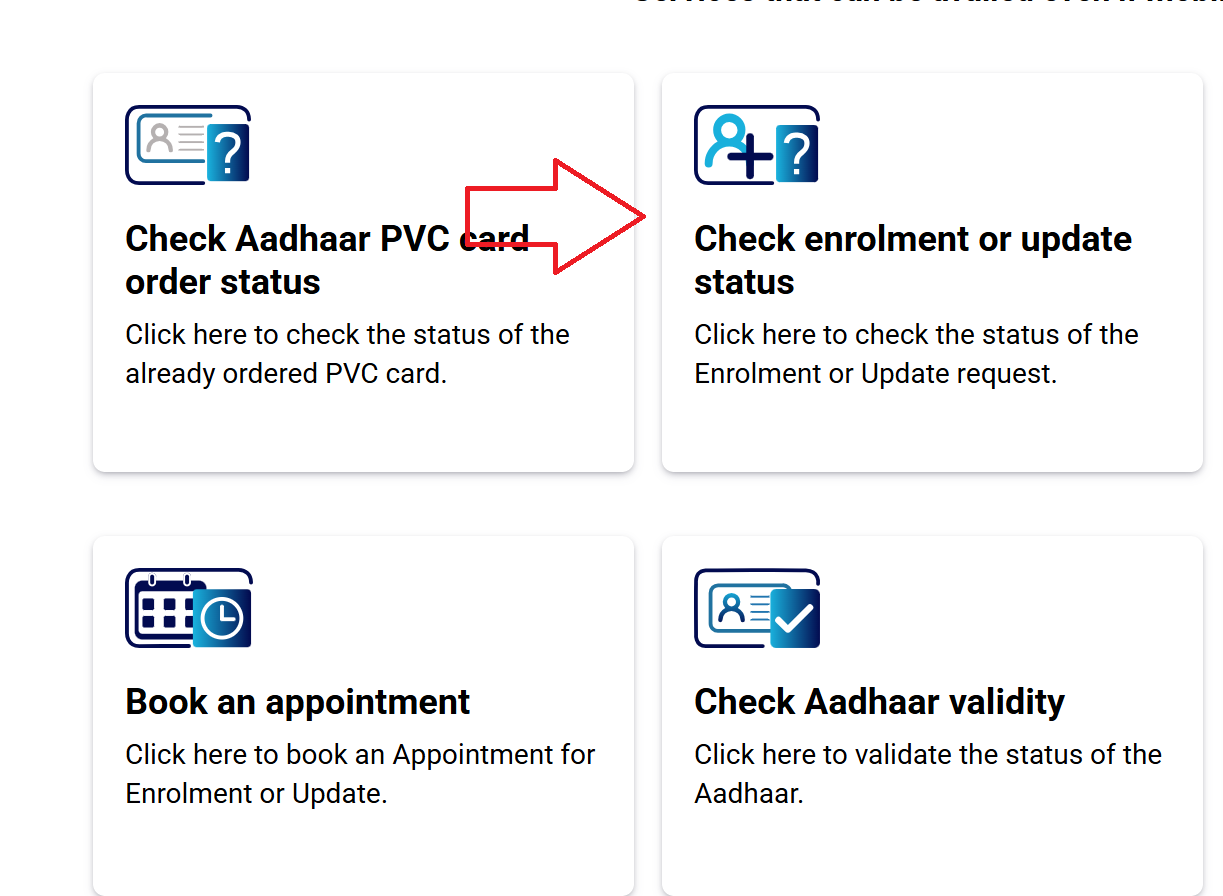
- Select the “Enrolment & Update Status” option.
- Enter your 14-digit Enrolment ID (EID).
- Enter the captcha code shown on the screen.
- Click on “Submit.”
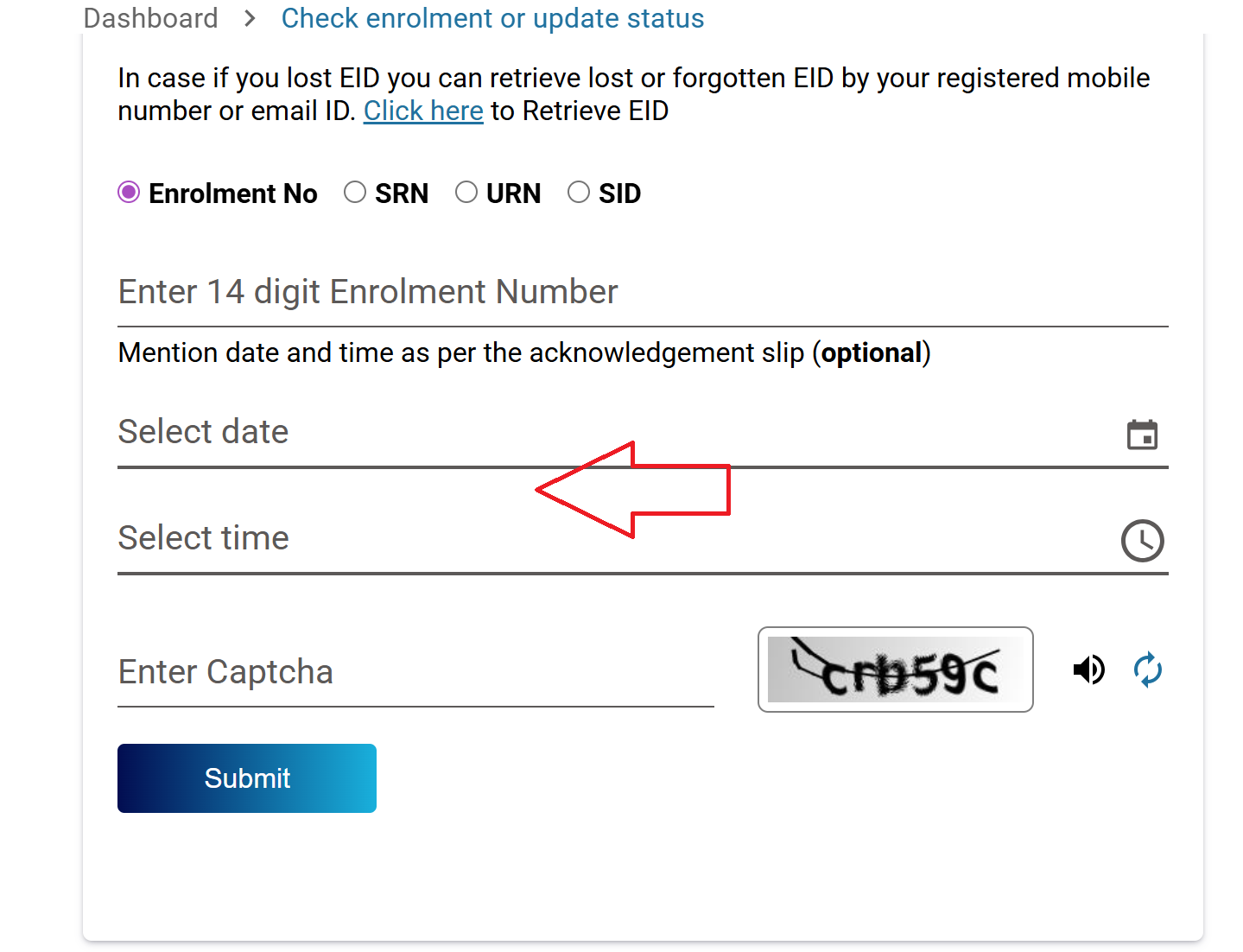
Your Aadhaar enrolment status will be displayed, showing whether it is under process, approved, or generated.
Aadhaar Enrolment – FAQs
Aadhaar enrolment is the process of registering a person with UIDAI to receive a 12-digit Aadhaar number by submitting personal details and biometric information at an authorised enrolment centre.
Any resident of India who has lived in the country for at least 182 days in the last 12 months can apply for Aadhaar, regardless of age.
Yes, Aadhaar enrolment is completely free for all residents.
You need documents for proof of identity, proof of address, and date of birth. These may include passport, voter ID, PAN card, birth certificate, or bank passbook.
Yes, newborns and children of any age can get an Aadhaar card, called a Baal Aadhaar, with enrollment starting from birth, though biometrics (fingerprints/iris) are only taken for kids under 5 (just a photo), then captured at ages 5 and 15, linked to a parent’s Aadhaar. You need the child’s birth certificate and a parent’s Aadhaar to apply at an enrollment center.
Aadhaar is usually issued within 7 to 30 days after enrolment, once UIDAI verifies the information.
If your application is rejected, you can visit an Aadhaar enrolment centre and apply again with correct documents.
You can book an appointment online, but the actual enrolment and biometric capture must be done in person at an Aadhaar centre.
No. Each person is allowed only one Aadhaar number. Multiple Aadhaar enrolments are not permitted.