
To update biometric data on your Aadhaar card, you must visit an Aadhaar Enrolment Centre in person, as this cannot be done online. This process is managed by the Unique Identification Authority of India (UIDAI), and is recommended every 10 years for adults over 15 to maintain accuracy, or sooner if biometrics change due to accidents, diseases, or authentication issues. It’s also mandatory for children at ages 5 and 15.
What Is Aadhaar Biometric Data?
Aadhaar biometric data includes:
- Fingerprints (all 10 fingers)
- Iris (both eyes)
- Facial photograph
This biometric data, combined with basic demographic information, helps in unique identification and access to government and financial services. Accurate and updated biometrics are required for Aadhaar authentication and secure transactions.
Reasons for Updating Biometrics
- Age-Related Changes: For individuals enrolled after age 15, UIDAI recommends updating biometrics every 10 years to account for natural changes in fingerprints, iris patterns, and facial features.
- Child-Specific Mandates: Children enrolled before age 5 must undergo a full biometric capture (treated as a new enrolment but retaining the original Aadhaar number) when they turn 5, including de-duplication to ensure uniqueness. Those enrolled between 5 and 15 years must update all biometrics upon reaching 15. This accounts for rapid physical growth.
- Events Causing Changes: Accidents, diseases, or conditions leading to biometric exceptions (e.g., lost fingers or eye damage) necessitate updates to avoid authentication issues.
- Authentication Failures: Known as “false rejects,” these occur when poor-quality or outdated biometrics fail during verification for services like banking or SIM activation. Updates improve capture quality with advancing technology.
- Quality Threshold Notifications: UIDAI may assess biometric quality from enrolment and notify holders if it falls below a threshold, requiring an update to enhance accuracy.
- Worn-Out Biometrics: Elderly individuals or those in manual jobs may experience faded fingerprints; updates provide fresh captures to resolve this.
Benefits of Updating Biometric Data
Regular biometric updates offer numerous advantages, ensuring your Aadhaar remains a robust tool for identity verification:
- Enhanced Security and Fraud Prevention: Fresh biometrics minimize misuse, identity theft, or duplication, as they are harder to forge than documents or PINs.
- Improved Authentication Success: Reduces false rejects, allowing smoother access to services like Direct Benefit Transfers (DBT), subsidies, and e-KYC for banking or mobile SIMs.
- Compliance with UIDAI Guidelines: Keeps you aligned with recommendations, avoiding disruptions in government benefits or transactions.
- Better Service Delivery: Accurate data facilitates hassle-free interactions with institutions, from hospitals to employers, and supports digital governance initiatives.
- Child Welfare Access: For Baal Aadhaar (blue cards for under-5s), updates at 5 and 15 ensure children can avail welfare benefits without issues.
- Overall Reliability: With technology improvements, new captures can be of higher quality, boosting the Aadhaar system’s efficiency.
- No Physical Card Reissuance: Post-update, download the e-Aadhaar online, saving time and resources.
When to Update Biometric Data
- Mandatory for Children: Once at ages 5-7 and again at 15-17.
- Recommended for Adults: Every 10 years after age 15 enrolment, or sooner if changes occur.
- As Needed: Upon UIDAI notification, authentication failures, or personal changes (e.g., post-accident).
- Timeline: Updates process in 30-90 days; track via URN.
Update Biometric Data
Biometric updates cannot be done online; they require an in-person visit to an Aadhaar Enrolment Centre (AEC) due to the need for live capture. Here’s the detailed process:
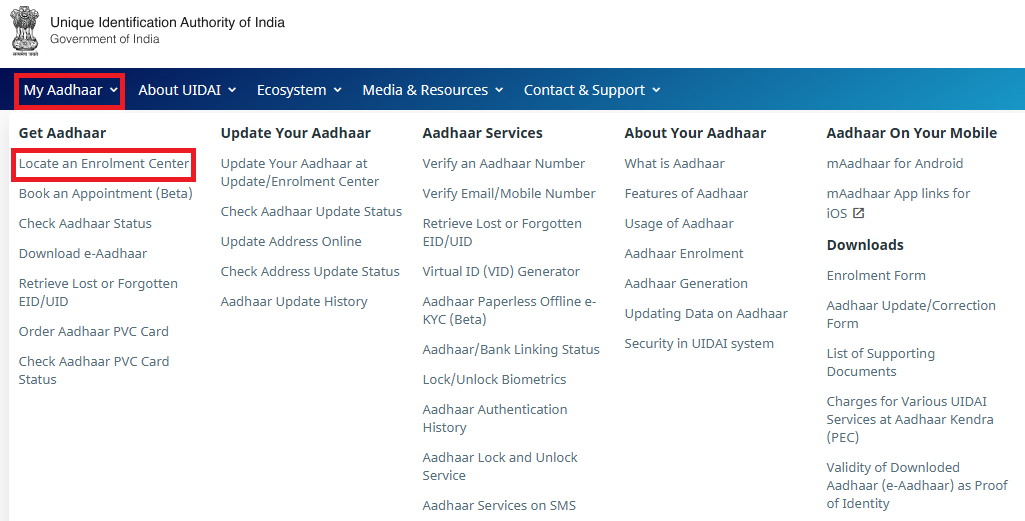
- Locate a Centre: Use the UIDAI locator at https://appointments.uidai.gov.in/easearch.aspx or the mAadhaar app. Centres typically operate 9:30 AM to 5:30 PM; book an appointment online to skip queues.
- Prepare Documents: Bring your Aadhaar card or e-Aadhaar, and any supporting Proof of Identity (PoI) or Proof of Address (PoA) if combining with demographic updates (e.g., passport, voter ID). For biometrics alone, minimal docs may suffice, but verify with the centre.
- Fill the Form: Obtain and complete the Aadhaar Update/Correction Form (download from uidai.gov.in). Specify biometrics to update (fingerprints, iris, photo).
- Verification: Submit the form; the operator verifies identity via biometric authentication or documents.
- Capture Biometrics: Provide fresh fingerprints, iris scans, and a photo using on-site equipment. The operator confirms quality.
- Operator Confirmation: The operator and supervisor authenticate the update.
- Pay Fee: Settle the applicable charge (details below).
- Receive Acknowledgement: Get a slip with a 14-digit Update Request Number (URN) and Service Request Number (SRN).
Aadhaar Biometric Update Status
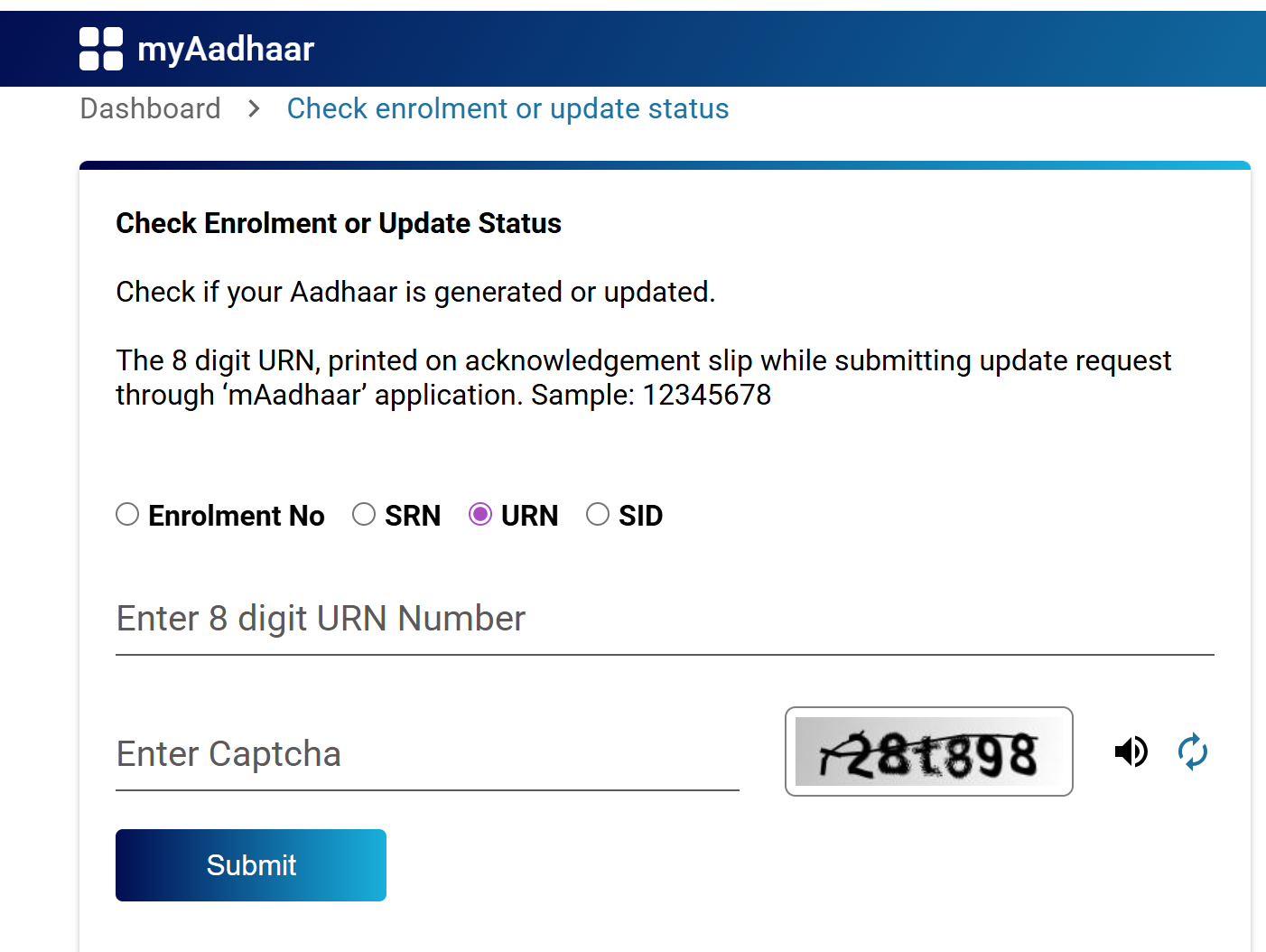
To check Aadhaar biometric update status, open the UIDAI My Aadhaar portal and go to the Check Enrolment or Update Status option. Enter your Update Request Number (URN) along with the captcha code, then submit the details. The system will display the current status of your biometric update, showing whether it is under process, approved, or completed.
Requirements and Documents
- Mandatory Items: Aadhaar number, registered mobile for OTP.
- Supporting Documents: Original PoI/PoA for verification (list at uidai.gov.in). For children, parents’ consent and biometrics may be needed initially.
- No Originals Scanned: Operators verify manually; no scanning unless for demographic combos.
- For Exceptions: Medical certificates for biometric changes due to health issues.
Fees for Biometric Updates
| Update Type | Fee (₹) | Notes |
| Biometric Update (Adults) | 125 | Includes fingerprint, iris scan and photograph |
| Demographic + Biometric Update | 125 | Only biometric fee is charged when both are done together |
| Mandatory Child Biometric Update (Age 5–7 or 15–17) | Free | Compulsory update required by UIDAI |
| Other Child Biometric Updates | 125 | Charged if not part of mandatory age-based update |
Special Cases
- Children (Baal Aadhaar): No biometrics under 5; parents’ biometrics used. Mandatory free updates at 5 (full capture) and 15 (all biometrics). No number change.
- NRIs and Foreign Nationals: Can update at Indian centres; HoF-based updates may not apply. Check uidai.gov.in for international guidelines (limited to biometrics).
- Elderly or Disabled: Centres assist; alternatives like iris-only if fingerprints fail.
- Limits on Changes: Name/DOB/gender have update limits (e.g., name twice lifetime); exceptions via regional offices.
Aadhaar Biometric Update – FAQs
Aadhaar biometric update is the process of updating your fingerprints, iris scan, and photograph in UIDAI records when they change or do not match correctly.
Children must update biometrics at the ages of 5 and 15. Adults should update biometrics if their fingerprints or iris scans fail during authentication or change over time.
No. Aadhaar biometrics (fingerprints, iris scan, and photograph) cannot be updated online. You must visit an authorised Aadhaar Enrolment or Update Centre where your biometrics are captured in person.
Aadhaar biometric updates usually take 7 to 30 days to be processed. In many cases, the update is completed within 10 to 15 days.
Yes. UIDAI recommends updating Aadhaar biometrics every 10 years to keep them accurate. This is especially important if fingerprints or facial features have changed over time.
You can check your biometric update status online by using the Update Request Number (URN) on the UIDAI My Aadhaar portal. It will show whether your biometric update is under process, approved, or completed.